Translate

Saturday, 18 January 2014

The Problem with Cross Laminated Timber is...


ESB UBC - Great Fun: Great Contractor, Engineer and Architect.

By John Boys

The new Wunderkind and current trend-darling in commercial construction is cross laminated timber (CLT) panels. Paired with glue-lam timbers and other engineered wood products it is making possible the construction of tall wood buildings. CLT is being touted as the green alternative to concrete, the building material that makes for speedy and efficient assembly, allows for flexible and innovative design, and all at a competitive cost to conventional materials such as tilt-up concrete.

And they are all of that – or rather they could be.

UBC O - Great Design/Build Team
Our team has had more experience in the installation of CLT in North America than most, and as heavy timber specialists (with roots in log-building and timber framing) we are excited by its potential and the possibilities it affords, but concerned that if the bottom-line expectations are not realized, that this revolutionary shift in how we build may disappear before it has proved it’s potential.

On projects where we have been given sufficient time to trouble-shoot, communicate, pre-plan and sequence our part of the work we can achieve the “just-like-lego-time-lapse-look-at-em-go scenario” that we are all anticipating.  Our team thrives on the well-coordinated dance of carefully rehearsed steps, meeting or exceeding our planned schedule when we finally “go live”. Who doesn’t like to look good!
UBC-O; interesting design

But it could be even better (and not only for us), if we and some of the other key trades and/or material suppliers were allowed both information and input much earlier in the design stage. Pre-planning in isolation and extrapolating information from incomplete final plans makes it awkward to contribute any solutions other than those which address absolutely un-workable details and/or connections.

While most trades people are not engineers, nor do all of us have a flair for design, cost effective, safe and even elegant solutions at material interfaces can be achieved if we are included (as appropriate) to define logical breaks in scope of work and to consider possible challenges long before these issues come up at the construction site.

UBC-O; connections +more connections
And it is on the job site, where the success of the design and planning can be gauged and measured. Assuming that the prime contractor, heavy timber specialists and material suppliers are competent, and that the plans and specifications are well thought out, a wonderful and choreographed dance begins to take place. If any of the above fall short, there are a lot of steel toed shoes getting stepped on…

So how is any of the above a “Problem with Cross-Laminated Timber”? In reviewing my words, it reads more like a rant about not being included!

In part, it is. I believe there are two things that threaten the future use of CLT in commercial structures, the first that we are often treating a new material as a substitute to the well understood materials (such as tilt-up concrete) to which we are accustomed.

3 D modelling. Not just for architects any more! (UBC-O)
Do we anticipate the challenging characteristics of this organic material (UV, rain, snow…shrinkage, expansion, iron staining…) and the associated costs? And are we taking full advantage of the benefits (precision CNC prefabrication, light weight, high strength to weight, visual qualities, insulation...)?

What tolerances are achievable and how does that affect specifications? Do the connection methods allow us to efficiently bridge the differing tolerances? Concrete+/- 30mm, steel +/- 3 mm, wood +/- 3mm, engineered connectors +/- 1mm, glazing systems....?

Using this new material effectively, in my opinion, requires a mind-shift that addresses its individual properties as well as a re-think of how we connect with the other components of the structure, and goes back to my pre-amble on pre-planning and brings me to the second point:

Pre-planning resolves breaks in scope, discovers solutions, arrives at efficient procedures and defines what is expected of the trades and helps them to submit well considered and inclusive bids resulting in fewer change orders and realistic budgeting.  In short, pre-planning can save money and my money is on the bottom line when determining the future of CLT.

UBC O CLT: as Espressed Structure; the talents ofMcFarland-Marceau
A great deal of our inspiration for CLT in North America is derived from the success stories in Europe and the common factor in all of these examples is that all the projects were built on a foundation that incorporated sophisticated 3D modelling and that a great deal of time (and money) was spent in pre-fabrication and sequencing strategies.
3D modelling and pre-planning means a significant up-front investment. 

It also involves a radical shift in how we approach design, engineering and the bid process and it allows all of us to be accountable. I wonder if that is possible…However it seems logical and expedient, that a revolutionary new type of structure should also generate a radical change in how we work together.

In closing, the “Log Builder’s Wife” tells me she could have made the point a bit more succinctly; her quote on the topic: “We can sing Green till we are Blue in the face, but if Green equals Red, then Black will trump Green!”).

I could go on at length and in more detail on this topic, but perhaps that is better saved for another day. In the meantime, I would be interested to know if I am alone in my concerns for the future of CLT in North America. Your comments welcomed.
 
"I'd like to harp on 3D modeling a little more..."

Wednesday, 27 November 2013

The Story of a Log Builder and a Timber Framer who Rounded up and Squared Off...


Or....When the Sum of the Total exceeds the Total of the Parts...
(Contributed by the "Log Builder's Wife")

We ran into our good friend Dai Ona at the WoodWorks Fair inVancouver when Johnny was delivering  his ” Tales of Blood  Chilling Horror from the Job-Site” presentation.
Dai is a timber framer (Dai-Zen joinery), whose roots are in log building and that’s how we know him. We used to do a lot of work with Dai when he first moved his timber frame shop to the interior and our collaborations with him are one of the favourite chapters of our working life.

These days we at Nicola LogWorks are doing a lot of heavytimber (CLT and Glue-lam) installation-only work in the commercial arena – and Dai’s shop is a going concern of its own; neither of us are doing much in the way of log work currently, but our approach and philosophy towards our work is defined and branded by our identity as log builders.
Log Builders are different. We cooperate. We communicate. We collaborate. (Some more than others). We generally see our competitors as colleagues – or even cousins – an extended family of like-minded craftsmen and inventors spread across this continent and spilling over into Europe, Japan and the Baltic regions.
As the “log builder’s wife”, it is no secret that I think John is the bees knees, but I also think that Dai is one of the most innovative, kind and interesting people I’ve ever met, and when the two of them joined forces to undertake some local timberframe projects a catalytic reaction occurred and a new entity was birthed.
We called it the “Good-Wood Synergy” (Dai’s name meaning good, and John’s last name a derivative of the French “Bois”  -  which as a bilingual nation, we all know means wood). They marketed themselves as the “the Zen-Boys”.

Together they pooled their strengths and resources to offer a level of service and quality that was superior to what they were able to offer on their own. The culmination of their work together was a very high end – design and build as you go local ranch house.
Some of the work was hand cut at our shop – some of it on Dai’s CNC machine. Dai’s curved lamination proto-type was on our site where we tweaked it a bit and contributed those components to the project also.  Our ability to achieve accurate fits with components fabricated at separate locations is because we both use sophisticated 3D modelling software.

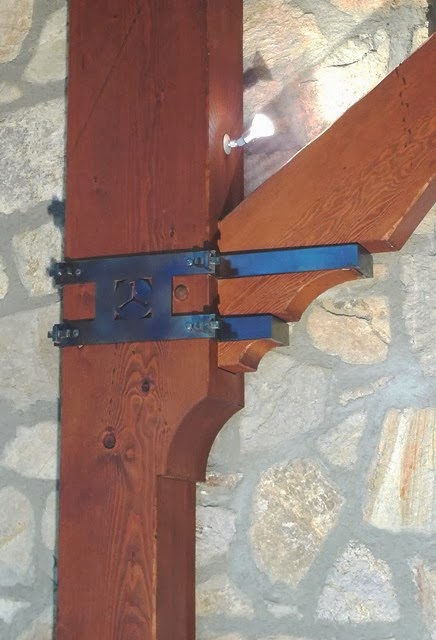
The designer of the building was open to ideas and suggestions which allowed the Zen-Boys to express themselves’ in other mediums besides wood and brainstorm some really unique and beautiful solutions; one being the metal joinery design and details. - notice how they celebrate and mimic wood joinery in the design! They may have come with these ideas on their own – but I doubt it – each new concept fueled another, each success inspired the next.  

It’s in our nature to be involved and engaged – the Nicola LogWorks slogan is " A Passion for Log & Timber Joinery", and I've heard Dai express our respective relationship to our work as our meat - or our food.

We are not just focussed on our scope of the work -  but with the all the materials and work that we tie into and with the materials and work that ties into ours. That defines the log building spirit at its best. We LOVE to build, and we are driven to build sucessful structures.

So we’ve brought the culture, skills and attitude of log building to our current work as HeavyTimber Specialists and that’s great – but we do feel like aliens speaking a different language at times.  
I think in the next post I’ll get John to tell you why…

 Signing off for now… 

“The Log Builder’s Wife”


Sunday, 20 October 2013

WE ARE BUILDERS... NOT BANKERS!


ONTARIO TO INTRODUCE THE PROMPT PAYMENT ACT - BILL 69!

Making the transition from residential log home and timber construction to subcontracting our skills as heavy timber specialists on commercial projects has been a bit of a culture shock for us at Nicola LogWorks.
In our residential work we are technically a subcontractor but because the log or timber package governs the scope and flow of the work, we are accustomed to a great deal of input and control. We define the specifications of our own work and often that of others where it ties into the heavy timber package.
We have our own “log-centric” contract, which very clearly states what we are and are not supplying. We also determine our payment schedule - heavily weighted at the front end to assure customer commitment and to purchase wood. (We have often marvelled at the trust invested in us by our customers as they send us 100’s of thousands of dollars – often only knowing us on the telephone).

Subcontracting our skills to the commercial world is an entirely different ball game and we have found the cultural differences in the two environments an interesting challenge. No matter how amicable our negotiations have been with the Prime Contractor prior to signing the contract – when the document arrives for review, we find our blood boiling every time.

Here’s why:

The paid when paid/if paid clause. While payment from time of invoicing may take up to 45 days (fair enough given the paperwork burden), the insidious little clause allowing the Contractor to withhold payments until they receive their payment from the Owner is a hardship for Subcontractors who typically are paying on receipt or at outside within 30 days. The Subcontractor has no way of knowing if the Contractor has been paid by the Owner, of if the Contractor has been diligent in keeping current with their billing to the Owner.
Delay in payment means that the Subcontractor is financing the project


Keep working with a smile on your face...another bitter little clause in most of these documents includes a stipulation that in the event of delayed payment or non-payment or dispute – the Subcontractor will continue to work to scope and schedule and not impede the progress of the project. (Bend over and smile).
The subcontractor’s costs escalate while he continues to finance the project and if payment is not forthcoming he maysoon be paying interest on his overdraft.


Substantial Completion…..Holdbacks Heldback
Standard practice in commercial construction is the withholding of 10% from each progress invoice which is a very good idea as this ensures that the Subcontractor has incentive to complete the job and to ensure that he has met his obligations to other sub trades and suppliers.  Generally holdbacks are due 45 – 55 days upon substantial completion of the work.
BUT...
Does this mean substantial completion of the Subcontractor’s scope? 
Or does this mean completion of the entire project?
Read the fine print – ask the question. Know what the Lien Laws are in the jurisdiction that you are working in, or you may find yourself subsidizing their project out of your personal bank account.

We know. Despite completing our work (autumn of 2012) to the specifications and scope and much verbal appreciation for our talented crew we are still awaiting our final payment for our installation of the cross laminated timber and glue-lams at the Fort McMurray Airport. 

GOOD NEWS!

So why was my Wife doing the happy dance? (see blog # 1)
Recently we were chasing payment for a project in Ontario. We were on the hook for materials, labour and installation as well as trucking travel and crane rental. We’d met and exceeded our scope, fulfilled the terms of the contract, paid our bills and three months after first payment was due we were still financing the project!

Why was the Contractor not honouring their part of the agreement?  You guessed it – the paid when/paid if clause. As we understand it the Contractor had been tardy in submitting their billing to the Owner, so we had the privilege of financing the work. We finally saw action when we apprised them of our intent to file a lien on the work. We also discovered, in the course of our research on procedure, the soon to be passed Bill 69 Prompt Payment Act, which addresses all of the above and more.

This bill will bring the dealings between Contractors and Subcontractors back into a more equitable relationship and end the hardship that some Subcontractors are bearing.

Not only will it benefit the Subcontractor – it will also be of significant value to the construction industry as a whole. It will broaden the available pool of subcontractors willing to bid commercial projects; it will allow those already in the commercial arena to undertake more work. (It is either foolish or impossible to bid new projects when your cash flow is tied up in financing previous ones) and while the bill is unique to Ontario, I think we can expect that the other provinces will follow suit if those of us in the industry get involved.

The best thing about it to my mind is that it will remove the opportunity for contention. More bitter than being the financier on these big buck high profile jobs, is how the relationship building and cooperation that is so much a part of the pleasure we derive from our work is destroyed when we have to get hardnosed about payment. 

To conclude - I would not want to leave you with the impression that all of these mega companies are deliberately using these clauses to their own ends or are all negligent in their responsibilities on behalf of the SubContractor.  But it does happen - and apparently a lot - given that Prompt Payment legislation has been initiated in the UK, Ireland as well as south of the border.

That said - we've also had great experiences with some of the big companies as well, both for their fairness in dealing with us and the efficiency and integrity of their company cultures. Notably:
Bird Construction Vancouver  - Earth Sciences Building and StudentUnion Building (CLT and Glue-Lam Install)
Kindred Construction Vancouver - UBC Okanagan Health and Wellness Centre
PCL Construction - College of the OkanaganTrades Canopy, and as of October 15th The Wood Innovation Design Centre in Prince George.